Search the documentation
Enter at least 2 characters
Enter at least 2 characters
 |
CAE Fidesys 9.0 Documentation |
The response spectrum is the dependence of the maximum relative displacement (relative velocity, relative or absolute acceleration) of the oscillator from the frequency (or period) at a given level of damping [R.Clough, J.Penzien-Dynamics structures p.253].
Consider a nonconservative oscillator when the support is excited (kinematic excitement).
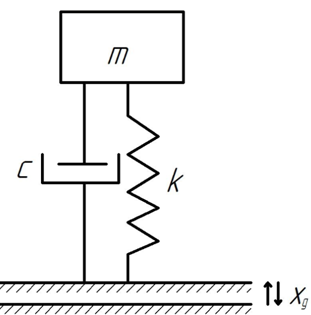
The equilibrium equation takes the form:

m - mass of the oscillator;
c - damping coefficient;
k - spring stiffness coefficient;
u",u',u - relative acceleration, relative speed and relative displacement, respectively;
x"g - acceleration of the base.
The equilibrium equation of the oscillator can be reduced to the form:

ξ - modal damping coefficient;
ω - is the natural frequency of the oscillator.
The solution of this equation is presented in the form of the Duhamel integral [R.Clough, J.Penzien-Dynamics structures p.253]

ωd - is the frequency of the damped system equal to:
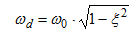
At a low level of damping (ξ<0.2) the frequency of the damping system can be assumed to be equal to its own.
The value S d, equal to:
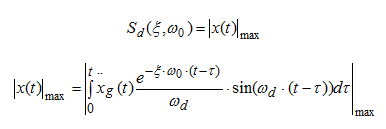
is called the relative displacement response spectrum.
Hence, the response spectra of relative velocity and absolute acceleration:
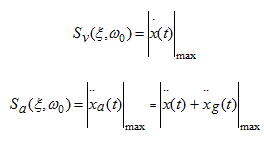
Sv - relative velocity response spectrum;
Sa is the response spectrum of absolute acceleration.
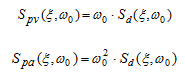
With a low level of damping , the following relationship between the spectra can be assumed response of relative displacement,relative velocity,absolute acceleration:
Consider a system with several degrees of freedom.
The equilibrium equation takes the form:

m - mass matrix;
c - damping matrix;
k - stiffness matrix;
u",u',u - relative acceleration vectors, relative velocity and relative displacement, respectively;
x"g is the acceleration vector of the base;
r is a vector of influence coefficients that characterizes displacement from a single displacement of the supports [R.Clough, J.Penzien-Dynamics structures p.280].
The natural frequencies are determined from the frequency equation:
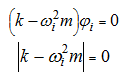
ωi - natural frequencies of the system;
φi are the proper forms of the system.
The system of equations is solved using the method of superposition of modes:
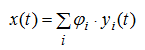
yi(t) - modal displacement coefficient.
Substitute Σφyi(t) into the equilibrium equation of the system and multiply from the left by φiT.
Using the orthogonality condition of the forms, we obtain:

ξi - modal damping coefficient on i - th fashion;
Gi is the modal participation coefficient of the i -th mode, which is determined by:
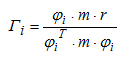
The equation differs from the equation of a single - mass oscillator only by the coefficient Gi.
Therefore, the maximum value of the modal displacement coefficient is defined by:
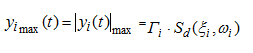
Then the maximum displacement on the i th mode is determined by:
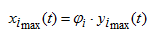
The maxima of modal responses are not reached simultaneously.
Therefore, there is a problem of finding the maximum value of the desired value according to all modes [more in A.N. Birbraer-Calculation of structures for earthquake resistance p.71].
Below are three ways to find the maximum value for all modes.
1. The method of summation by the absolute value of responses (Absolute sum)
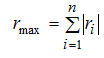
2. The method of the square root of the sum of squares of modal responses (Square root of sum of squares)
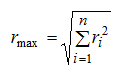
3. The square root of the sum of combinations of products of modal responses (Complete quadratic combination)
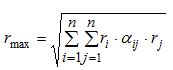
where αij is the correlation matrix equal to:

when β = ωi/ωj.
If ξ = 0, then the correlation matrix αij is a single one.
Here you can see: