Search the documentation
Enter at least 2 characters
Enter at least 2 characters
 |
CAE Fidesys 9.0 Documentation |
Natural frequencies and their corresponding forms vibrations characterize the response of a structure (or other object of study) to external dynamic influences and relate (along with some others parameters) to the category of dynamic characteristics of the structure. Their definition is usually required for:
next calculation of the dynamic reaction (forced oscillations) of the structure using the decomposition of the desired solution according to the modes of natural oscillations, i.e. in normal coordinates, or by the superposition method mod - as in time (dynamic time analysis), and in the frequency domain (frequency, or harmonic analysis);
verifications design model of the structure based on the results of dynamic tests a full-scale object or its small-scale physical model (by comparing calculated and experimental dynamic characteristics);
planning experiments, in particular, determining the places of application of dynamic impacts and sensor installations;
justifications measures to eliminate possible resonances (by changing parameters of the structure or conditions of its loading).
Natural frequencies and eigenmodes are determined by numerical solution of the generalized eigenvalue problem. In the case of finite element analysis of mechanical vibrations, the inertia matrix (mass matrix) is used in the formulation of the eigenvalue problem and the stiffness matrix of the elastic system modeling the structure; internal structural damping is usually neglected due to its small size. In other problems, for example, stability or thermal conductivity, we consider matrices of coefficients corresponding to these problems.
The immediate result of the numerical solution are n found proper pairs (n does not exceed the number of degrees of freedom of the finite element model, and as a rule, much less). Each such pair consists of an eigenvalue and of the eigenvector. When analyzing mechanical vibrations , each the eigenvalue is the square of the proper circular frequency of vibrations according to a certain tone, or mode (hence the term modal analysis), and the eigenvector - the shape of the oscillations.
Natural oscillation frequencies can be observed in the design, which was taken out of the static equilibrium position, for example, by applying a time-varying external influence of a special kind. Impact it must be either short-term (pulsed) - in this case, it is excited several tones of their own vibrations at once, which gradually fade out, or periodic sinusoidal - at the same time excited and maintained fluctuations of the corresponding frequency. The point of application of the sinusoidal effect it must be in the antinode of the shape of the excited oscillation tone.
The shape of the vibrations by any tone is a distribution of the values of the displacements of the points of the structure in a certain coordinate a direction that is characteristic of this tone and does not change over time. The shape of the oscillations can also be considered as a set of relations of amplitudes displacements at different points of the structure to the amplitude at any selected point or to the conditional amplitude obtained from the condition normalization of eigenvectors.
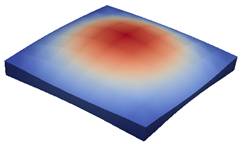
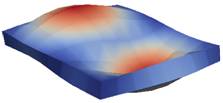
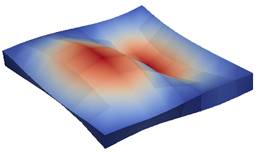
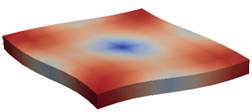
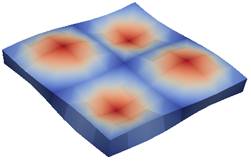
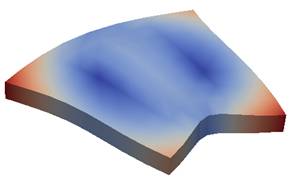
The concept of the eigenmode is illustrated in Table 1, which presents the shapes of the first 7 modes of natural oscillations of a thin-walled plate calculated using CAE Fidesys.
Table 1. - Eigenmodes of a thin-walled plate
|
|
1st form |
2st form |
|
|
3st form |
4st form |
|
|
5st form |
6st form |
In general, the values of eigenfrequencies and eigenmodes structures depend on their geometric characteristics, properties of structural materials and boundary conditions. Influence of boundary conditions on eigenforms shown in Fig. 1 and 2 on the example of a beam. The first variant of the boundary conditions (Fig. 1) corresponds to the cantilever fastening of the beam, the second (Fig. 2) - its hinge operation.
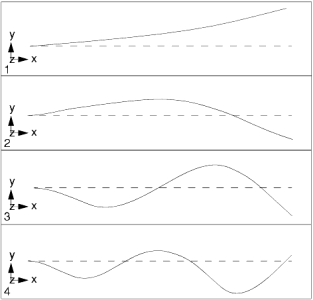
Fig. 1 - Eigenmodes cantilever beam
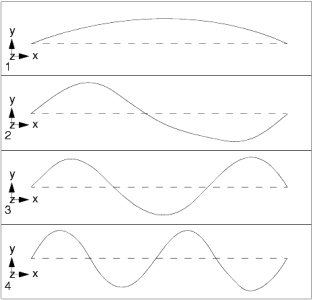
Fig. 2 - Eigenmodes pivotally supported beams
However, if you change only the material properties of the beam in question (for example, Young's modulus or density), then for each variant of the boundary conditions, its natural frequencies will change, but the eigenmodes will not.