Search the documentation
Enter at least 2 characters
Enter at least 2 characters
 |
CAE Fidesys 9.0 Documentation |
The damping matrix [C] in the most general form has the form:

where α is a constant multiplier to the mass matrix,
β is a constant multiplier to the stiffness matrix,
βj is a constant factor to the stiffness matrix, depending on the material,
βc is a variable multiplier to the stiffness matrix (applicable in harmonic analysis, used to ensure the constancy of the degree of damping ζ, regardless of the frequency ω):
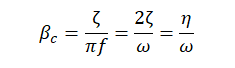
where ζ is the constant damping ratio. According to the presented expression, ζ must be equal to n/2.
where n is the loss factor;
f is the frequency, in harmonic analysis it varies in the interval from the initial (fb) to the final (fe).
[Cζ]- frequency-dependent damping matrix; [Cζ] can be expressed in terms of ζr - the degree of damping for the rth own fashion, but never calculated explicitly.
ζ - constant degree of damping
[Ck] is the damping matrix of the kth element (Nele - the number of elements having their own damping matrix).
In Fidesys, the damping matrix [C] in the most general form has the form (Fidesys Theory Reference):

where α is α - damping of the mass matrix;
β - damping of the stiffness matrix;
ξ - structural damping;
αjm is the damping coefficient of the mass matrix material;
βjm is the damping coefficient of the stiffness matrix j-th material;
ξjm - structural damping of the j-th material;
Ck - element damping matrix;
Nm - the number of materials with a given damping;
Ne - the number of elements with the specified damping.