Search the documentation
Enter at least 2 characters
Enter at least 2 characters
 |
CAE Fidesys 9.0 Documentation |
Cylindrical coordinate system (CCS) is usually used in axisymmetric problems, i.e., in such problems in which the axis of rotation can be distinguished. CCS is used for fastening in radial, tangential or axial direction.
In CAE Fidesys, for the correct use of the CCS, the X axis must be located along the axis of rotation, while the position of the Y and Z axes is not so important. In this case, the X direction will be responsible for the radial direction, Y for the tangential direction, Z for the axial direction. When setting the boundary conditions in which the CCS will be used, this should be taken into account - which axis in the CCS is responsible for which direction.
For example, for the cylinder segment shown in Figure 1, the X-axis of the CCS must be directed along the Z-axis of the global coordinate system. In this case, the X component of the boundary condition in the CCS will be responsible for the radial direction, Y for the tangential direction, and Z for the axial direction.
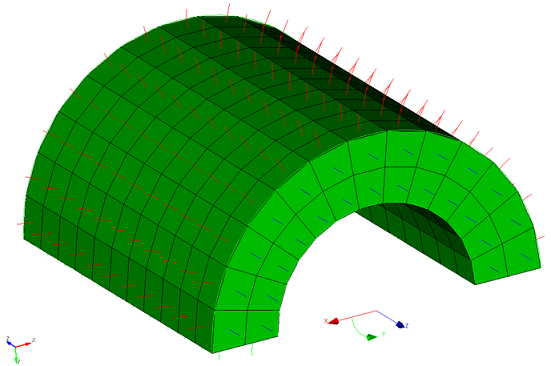
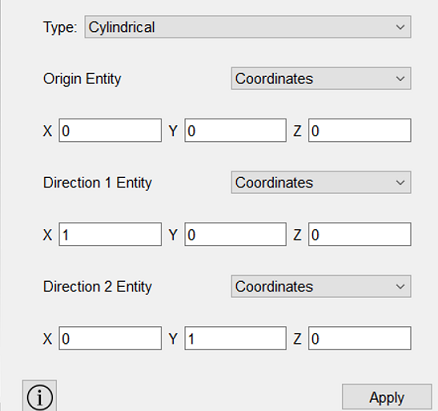
In the coordinate system settings widget, you can use direction cosine values in the global coordinate system, numbers of reference nodes or vertices.
An example of solving a problem with a cylindrical coordinate system: Calculation of a shaft segment in cylindrical coordinate system.