Search the documentation
Enter at least 2 characters
Enter at least 2 characters
 |
CAE Fidesys 9.0 Documentation |
Ensuring the stability of slopes and escarpments is one of the key tasks of engineering protection of territories, especially in conditions of difficult terrain. and the activation of landslide processes.
The regulatory document defining this method is SP 116.13330 "Engineering protection of territories, buildings and structures from hazardous geological processes."
The quantitative assessment of stability in the framework of nonlinear soil mechanics yields the strength reduction factor (SRF).
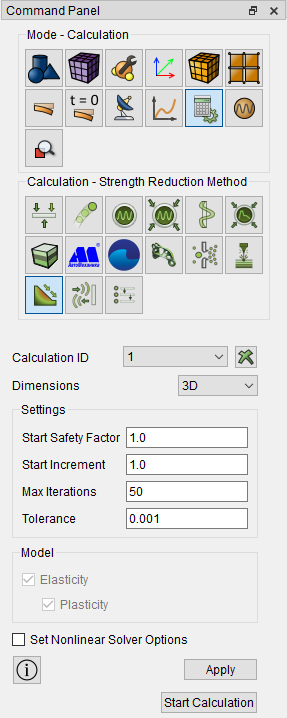
The following settings are available to the user:
Dimemsions: 2D, 3D;
Settings SRF: Start Safety Factor, Start Increment, Max Iterations, Tolerance.
Nonlinear Solver Options.
Start Safety Factor - the initial SRF, which will be taken into account when calculating the series for the first time. Range of values: a positive value.
Start Increment – the initial step size by which the SRF will increase on the first calculations of the series. Range of values: a positive value.
Max Iterations - the maximum number of iterations, which determines the maximum number of calculations in a series. Range of values: a positive value greater than 5.
Tolerance is a parameter that determines the accuracy of the calculation SRF. The range of values: the value is greater than 1e-6 and less than the Start Increment.
The essence of the method is a proportional decrease in the initial strength characteristics of the soil (adhesion and angle of internal friction) before the onset of plastic deformations, which corresponds to the exhaustion of the bearing capacity of the slope. In other words, the essence of calculating the SRM is to find the SRF at which the numerical model loses stability. For this purpose, a series of elastoplastic calculations is performed, each of which changes the plastic characteristics of the materials.
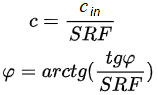
At each stage of the calculation, the cohesion and the angle of internal friction are calculated using the appropriate formulas:
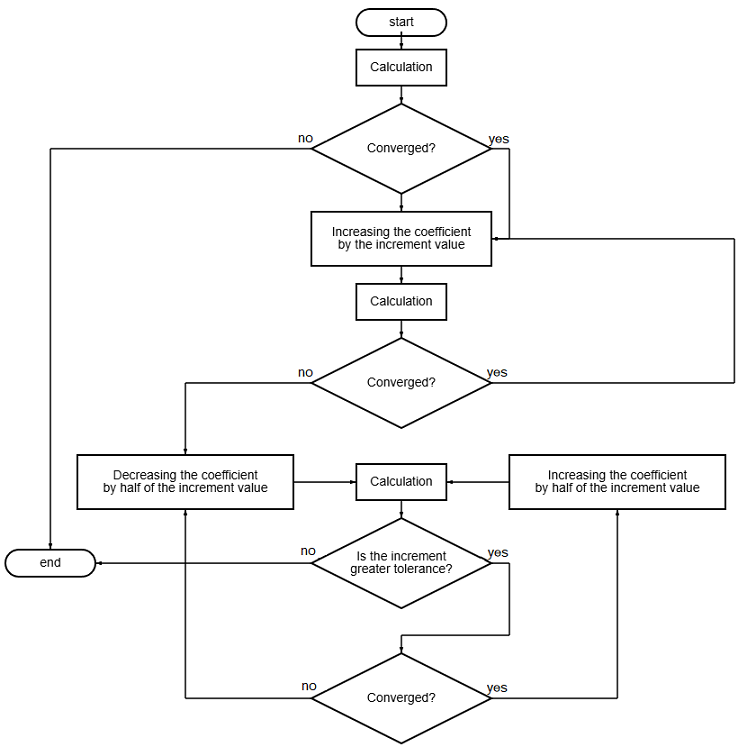
The algorithm can be divided into 3 main blocks running one after the other:
The first calculation.
The model is being checked for correctness. Such a criterion is its convergence.
A sub-series of calculations with monotonous increase SRF.
During this sub-series, SRF increases monotonously by the Start Increment value until at least 1 calculation of the sub-series diverges.
The main sub-series of calculations.
With each calculation, the Increment is divided in half. If the calculation converges, then the SRF increases by half the Increment. If the calculation has diverged, it decreases.
The criterion for completing the series is the condition: The increment is less than the Tolerance.
The calculation algorithm implemented in CAE Fidesys can be illustrated using a flowchart.
The available model properties and calculation settings are presented in tabular form:
| Dimensions | 2D | 3D |
| Task type | Plane Strain | - |
| Block category | Plane | Solid |
| The criterion of plasticity of the material | The Drucker-Prager criterion and the Mohr-Coulomb Criterion | |
After starting the calculation, in Command line will display information about the calculation series.:
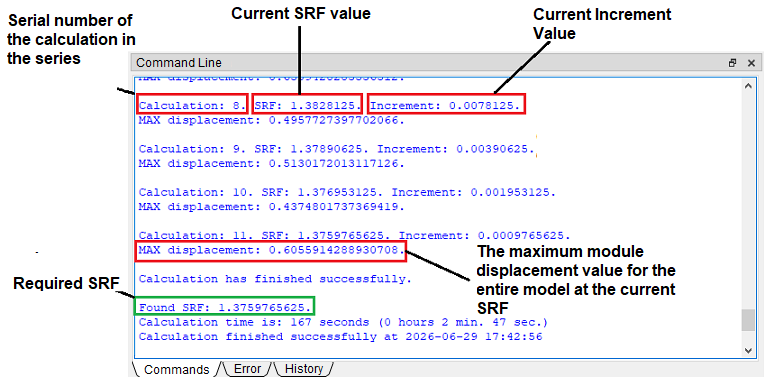
Until the calculation is completed, all the calculation results are collected in the folder:
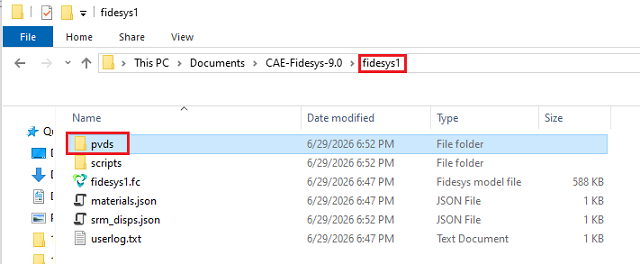
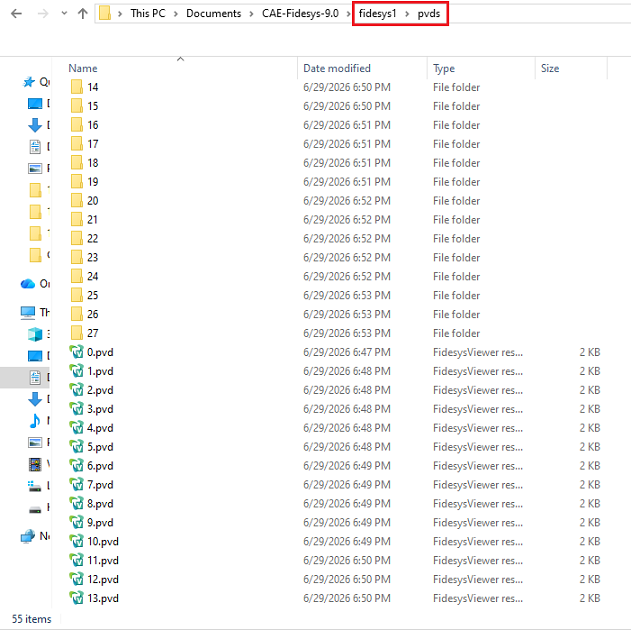
The file name corresponds to the serial number of the calculation in the series. This is necessary so that the user can view the interim calculation results.
The series of calculations may end for two reasons:
When calculating SRM, the specified Tolerance SRF was achieved.
In this case, the fidesys1\pvds folder is cleared and only the calculation result for the desired SRF remains.
When calculating SRM, Max Iterations were reached.
In this case, the calculation will fail with an error: "ERROR: Maximum iteration count reached before convergence.".
The fidesys1\pvds folder will be saved.