Search the documentation
Enter at least 2 characters
Enter at least 2 characters
 |
CAE Fidesys 9.0 Documentation |
When rotating, gyroscopic forces and moments act on the structure. Their appearance and physical meaning may be different depending on the selected reference system: rotational (O’X'Y’Z’) or stationary (OXYZ).
Figure 1 shows the position of point P in two reference systems.
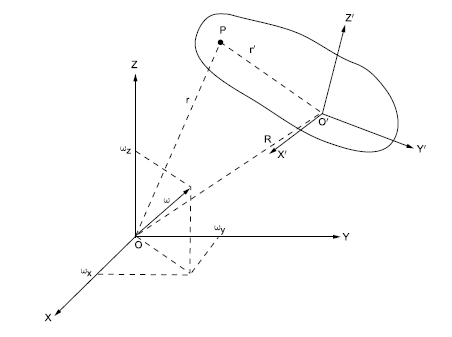
Figure 1 – Position of point P in stationary and rotational reference systems
The following notations are given in the figure:
O’X'Y’Z’ – rotational reference system;
OXYZ – stationary (global) reference system;
ω – angular velocity vector in the stationary reference system;
R – radius vector of point O’ in the stationary reference system;
r – radius vector of point P in the stationary frame of reference;
r’ – radius vector of point P in the rotational frame of reference.
In Fidesys (starting with version 8.0), in modal analysis it is possible to take into account gyroscopic forces when obtaining results, including for constructing the Campbell diagram.
The equation of motion of a finite element model in a stationary frame of reference:

where:
M, C, K – matrices of mass, linear stiffness, damping;
P(t) – vector of external forces (equal to zero in modal analysis);
Gs – gyroscopic matrix in a stationary reference frame.
The gyroscopic matrix in a stationary frame of reference can be obtained by substituting the functions of the displacement form into the expression for the kinetic energy of the gyroscopic moment.
If the model rotates around the global X axis, then the kinetic energy will be equal to:
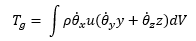
where:
u – linear displacement along the global X-axis;
ρ – mass density of the material;
θ̇x, θ̇y, θ̇y – derivatives of angular displacements with respect to time (θ̇x = ωx).
Equation of motion of the finite element model in the rotational frame of reference:

where:
Gr – gyroscopic (Coriolis) matrix in the rotational frame of reference, equal to:
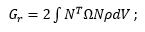
N – matrix of shape functions;
Ω - matrix of angular velocity projections onto global coordinate axes, equal to:
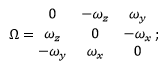
Ksp – additional stiffness matrix that arises under the effect of angular velocity vector (in English literature – spin softening):
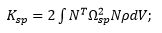
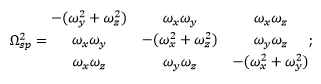
Ωsp - matrix of angular velocity projections onto global coordinate axes, the square of which is equal to:
Also, in two reference systems, it is possible to add a stiffness matrix from preloading by static analysis (preloading will be taken into account both from angular velocity and from other external influences).