Search the documentation
Enter at least 2 characters
Enter at least 2 characters
 |
CAE Fidesys 9.0 Documentation |
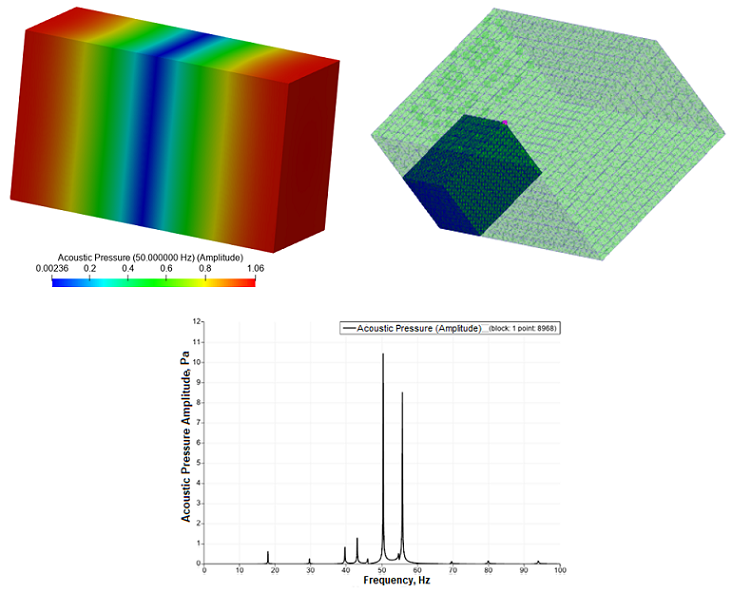
Acoustic calculations study the propagation of sound pressure waves in an acoustic environment. Acoustic or sound waves can be caused by elastic disturbances arising during deformation of a solid structure, in contact with the acoustic environment. New element type allows you to model related problems of elastic deformable solids with acoustic media.
Acoustic calculations are available for two types of analysis – modal and frequency. For an acoustic environment, disturbed and excess pressures are studied and density relative to the initial equilibrium states. Modal analysis allows you to determine the natural shapes and frequencies of a volume of liquid or gas, as well as eigenforms arising as a result of the interaction of elastic bodies with an acoustic environment. Frequency analysis calculates the system response as a function depending on the frequency of excitation of the external load. Data calculation types are used, for example, to eliminate noise in transport in accordance with sanitary standards, to analyze the spread of noise in buildings and structures, development of acoustic filters (silencers).
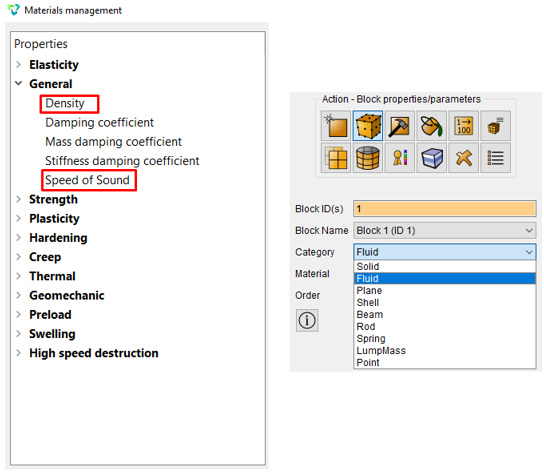
To define the acoustic environment, you need to create material at a speed sound and density and create an “acoustic environment” (FLUID) block with this material. Volumetric elements of all orders are supported, including spectral.
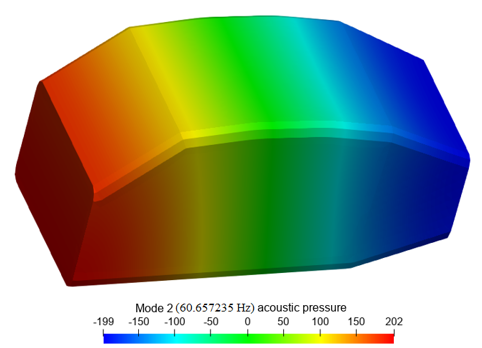
The result of the calculation of the modal analysis of the free acoustic volume there will be forms of acoustic pressure distribution:
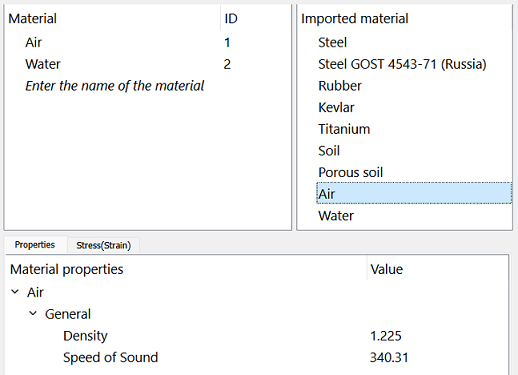
For ease of use, standard materials have been added to the library two acoustic materials – Air and Water.
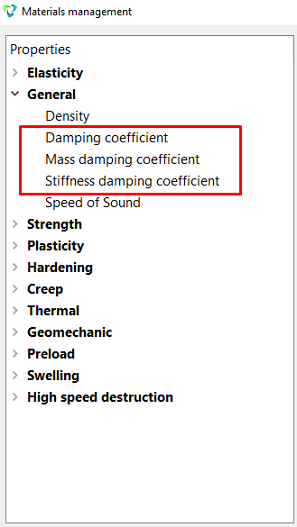
Related acoustics problems model the interaction of solid deformable bodies with acoustic (liquid or gaseous) media. Related tasks acoustics in CAE Fidesys are calculated relative to the potential function acoustic speed. The most preferred method for determining interaction (FSI) between the solid and the acoustic medium is the general geometry, providing a conformal mesh between the elements of deformable bodies and acoustic environment. If it is necessary to take into account energy dissipation, it is recommended to use damping coefficients for materials of elastic bodies.
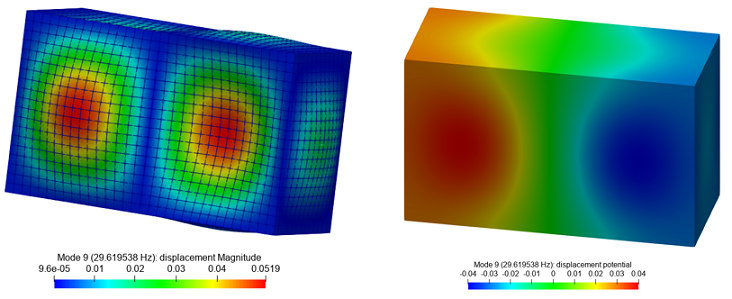
The result of the modal analysis of the associated problem will be the distribution forms acoustic velocity potential over the volume of the acoustic medium and displacement elastic body:
The result of the frequency analysis of the associated task will be response graphs on harmonic influence in nodes - acoustic pressure for acoustic environment and displacement, speed, acceleration for an elastic body, as well as forced forms of distribution of acoustic pressure, displacements, velocities, accelerations.