Search the documentation
Enter at least 2 characters
Enter at least 2 characters
 |
CAE Fidesys 9.0 Documentation |
External integration of Flow Vision is set in the command panel Mode - Calculation Settings, Calculation settings - External CFD integration.
The entire section is an implementation of modeling based on the integration of industrial engineering software packages Flow Vision and CAE Fidesys.
The FlowVision software package is used to solve various applied problems in various areas of industry. Its popularity is based on the fact that it allows solving complex non-traditional problems located at the intersection of various disciplines, as well as on the paradigm of complete automation of such labor-intensive processes for an engineer as building a computational mesh. FlowVision is a software package that is completely alienated from developers. It has a developed graphical interface, a system for specifying a calculation project and a system for visualizing flows using various methods. In addition, the FlowVision PC provides the user with the ability to calculate integral flow characteristics on various surfaces and in volumes of various objects.
FlowVision PC is based on the finite-volume approach to approximating the basic equations of fluid motion. It implements explicit and implicit methods of integrating these equations. The PC has an automatic builder of an unstructured mesh with the ability to locally dynamically adapt it. The PC implements two-level parallelism, allowing for efficient calculations on computers with distributed and shared memory simultaneously. FlowVision has a wide range of physical and mathematical models - turbulence (URANS, LES, ILES), combustion, mass transfer taking into account chemical transformations and radioactive decay, electrohydrodynamics. FlowVision models incompressible (density independent of pressure) and compressible flows. FlowVision allows you to calculate flows that contain hypersonic zones, stagnation regions, and recirculation zones. This is achieved by using an all-velocity splitting method for solving the Navier-Stokes equations.
FlowVision allows solving interdisciplinary problems: modeling multiphase flows using the VOF method, specifying the motion of bodies (movement of impermeable boundaries) along a fixed computational mesh, modeling flows in rotating machines using the sliding mesh method, solving problems of interaction between a liquid and a structure using the method of two-way conjugation of FlowVision with finite element PCs.
To ensure joint calculation, two software packages need to exchange relevant information. For this purpose, a software module was developed that implements two-way interaction between the CAE Fidesys and Flow Vision packages. To exchange information with FlowVision, the Direct Coupling Co-Simulation protocol is used, which is compatible with the FE code Abaqus. The basic diagram can be depicted as follows:

A complete FE model of an elastic body is prepared in CAE Fidesys and transferred to PC FlowVision for calculating the body as part of the system.
An iterative process is used to determine the stress-strain state and the corresponding flow distribution. First, the flow around the undeformed body is calculated.
The calculated impact in the form of surface forces is transferred to CAE Fidesys to calculate the deformed state of the solid. Then, the flow is calculated again, but this time taking into account the deformed state. Such steps are repeated until the additional displacements become zero, which is an indicator that the iteration process has converged. This algorithm can be written as a flow chart:
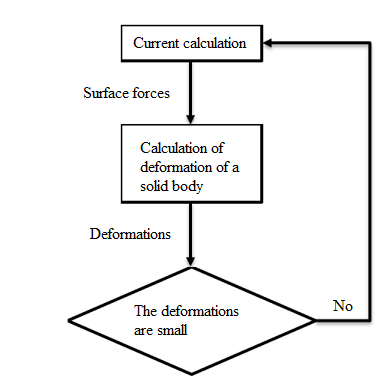
Given a solution for a particular time instant, a time step is performed using an implicit scheme. Within this scheme, a series of iterations is also performed until convergence is achieved. After that, the solution is assumed to have been found at the next time step.