Search the documentation
Enter at least 2 characters
Enter at least 2 characters
 |
CAE Fidesys 9.0 Documentation |
In the calculation settings, when choosing the 2D dimension, the following plane state are available: plane strain, plane stress, axisymmetric.
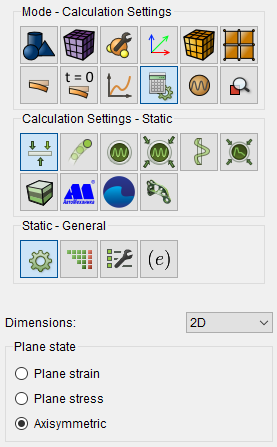
A fragment of the script for setting an axisymmetric task type looks like this:
analysis type static elasticity dim2 axisymmetric
That is, after specifying the dimension, the keyword axisymmetric is written, by analogy with how plane strain and plane stress are used in other cases.
In the case of an axisymmetric type of planar problem, the geometry is constructed in the region x ≥ 0 (the presence of body points in the region x ‹ 0 will lead to an error). The Y-axis serves as the axis of symmetry. The constructed two-dimensional problem will be equivalent to a similar three-dimensional problem, in which the body is obtained by rotating the original shape around the Y axis, as well as the corresponding symmetrical distribution of anchors and loads.
Formally, if in a 2D axisymmetric problem the point x = X,y = Y if it lies in the body, then this means that in the corresponding 3D problem, the entire circle lies in the body x2 + z2= X2, y = Y. And vice versa, if in a 2D axisymmetric problem the point x = X,y = Y if it does not belong to a body, then this means that in the corresponding 3D problem the entire circle x2 + z2= X2, y = Y it does not lie in the body.
If in a 2D axisymmetric problem for the point x = X, y = Y there is some fixation or load, then in the corresponding 3D problem the same fixation or load applies to the entire circle x2 + z2= X2, y = Y.
An important feature of the axisymmetric problem: if some part of the figure lies on the very axis of symmetry x = 0, the movement is automatically fixed for it ux= 0. This pinning is not displayed in the tree, it occurs already in the process of solving the problem due to symmetry.
Acceptable types of tasks for axisymmetry: static calculation, transient analysis, mode frequency analysis.
Acceptable models for axisymmetry: elasticity, plasticity, nonlinear geometry, heat transfer, pore fluid transfer.
Acceptable types of grids and element orders for axisymmetry: triangular finite and spectral elements, quadrangular finite and spectral elements.
Acceptable boundary conditions: displacement, pressure, velocity, angular velocity, contact, temperature, convection, heatflux, pore pressure, fluid flux, periodic condition.