Search the documentation
Enter at least 2 characters
Enter at least 2 characters
 |
CAE Fidesys 9.0 Documentation |
Strength criteria are available in FidesysViewer in a separate filter.
For the filter to become active in FidesysViewer, it is necessary in the preprocessor In the output field settings, check the box “Output material properties” (Fig. 1).
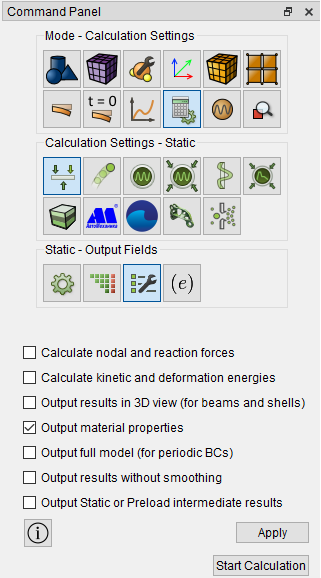
Figure 1. Solver Settings
Strength criteria are available in FidesysViewer as a separate filter.
Safety factor (Menu - Filters - Alphabetical - Safety Factor)
Formula for strength criteria.
σt — uniaxial tensile strength;
σc — uniaxial compressive strength;
σm — von Mises stress;
c — cohesion;
φ — angle of friction;
σ1 — first principal stress;
σ2 — second principal stress;
σ3 — third principal stress;
n — safety factor whose field should be displayed.
Used in the assumption of brittle fracture. Along isolines σ1 construct isolines of safety factors n = σt / σ1.
Used in the assumption of ductile fracture or if it is not allowed plastic state.
Isolines of safety factors are constructed using isolines σi n = σy / σm or n = σ0.2 / σm, where σy or σ0.2 – physical or proof strength.
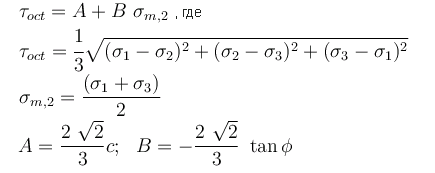
Used for mixed destruction.
Isolines of coefficients are constructed using the fields σm and σ1 safety factor:
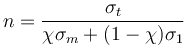 , где
, где

Safety factor isolines:
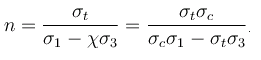
It turns out as a special case from Mohr’s theory with:
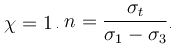
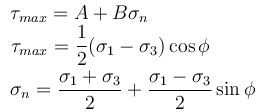 - normal stress on
the plane of destruction
- normal stress on
the plane of destruction
A = c; B = - tanφ
or
If the strength limits σc and σt are given, then
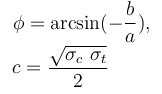
where a = σt + σc;
b = σt - σc < 0 (at b > 0 angle of internal friction becomes negative, which is unacceptable).
Safety factor:
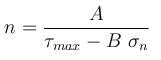
or

Safety factor
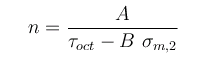
Strength criterion:
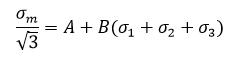
The strength criterion is met if the following is true:

where

Since the Drucker-Prager yield surface is inscribed in the Coulomb-Mohr yield surface, then in terms of the angle of internal friction and cohesion:

Safety factor:

This criterion evaluates the destruction of the model material under the influence of plastic deformations.
Another name for the Mohr-Coulomb criterion
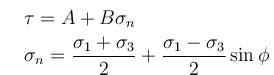 - the normal stress
at failure;
- the normal stress
at failure;
A = c; B = - tanφ;
The disadvantage is explained by the fact that compression should lead to strengthening, and compression correspond to negative values of σn
c = - τB - shear (torsional) strength, which user input for each material, or cohesion;
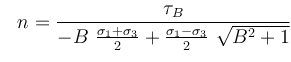
The Hook-Brown criterion in positive compression stresses:

The strength is maintained at

The Hook-Brown criterion in negative compression stresses:
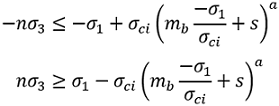
The strength is maintained at

that is, when
