Search the documentation
Enter at least 2 characters
Enter at least 2 characters
 |
CAE Fidesys 9.0 Documentation |
Links of type Rigid Body Element 3 define the movement of the slave node as a weighted average of the movements of a set of leading nodes. This element is a useful tool for distributing applied load and masses in the model. The element is implemented as a set of coupling equations, in in which the movements of the slave node are limited by the movements of other nodes. Let index q denote a slave node and index k denote one from the leading nodes with the corresponding weight WTi. The RBE3 element suggests that the displacements of the slave and master nodes are small. This can be seen from the definition matrix S, since this matrix uses the original coordinates of the nodes.
Slave node;
Leading nodes;
Connections components of the slave node (X,Y,Z,Mx,My,Mz);
Connections components of the slave node (X,Y,Z,Mx,My,Mz);
Weighting coefficients of leading nodes;
Option for distance-dependent coefficients.
Let's introduce matrices  и
и  .
.
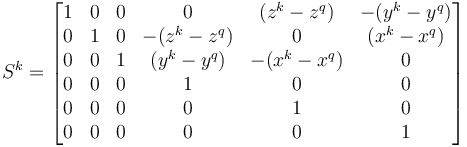 ,
,
where x,y,z with index q are the coordinates of the slave node, and with index k leading nodes.
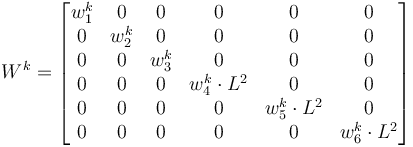 .
.
 - average
distance from the slave node to all masters.
- average
distance from the slave node to all masters.
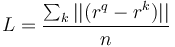 , if average
the distance is 0, then
, if average
the distance is 0, then  .
.
Weights are determined depending on the distance dependence option, when disabled:
 for degree
freedom not specified in the settings of the master nodes.
for degree
freedom not specified in the settings of the master nodes.
 for the specified
one. If the option is enabled, then for the specified degrees:
for the specified
one. If the option is enabled, then for the specified degrees:
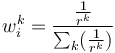 , where r^k
- distance from the master node to the slave.
, where r^k
- distance from the master node to the slave.
With and without enabled distance weighting option for degrees freedom of movement must always be specified greater than zero in order to avoid matrix degeneracy
 .
.
We find the inverse matrix of the sum over all leading nodes:
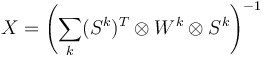
Coefficients of coupling equations:
 .
.
The constraint equations themselves:
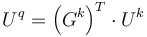 .
.
Equations associated only with the specified degrees of freedom are added slave node.