Search the documentation
Enter at least 2 characters
Enter at least 2 characters
 |
CAE Fidesys 9.0 Documentation |
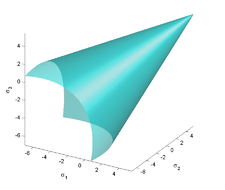
The Drucker-Prager strength criterion is a load-dependent model that determines the behavior or destruction of some materials under the influence of plastic deformation. This criterion was developed to describe plastic deformations of clay soils, and it can also be used to describe destruction of rocky soils, concrete, polymers, foam and other pressure-dependent materials.
The Drucker-Prager criterion:

Equivalent voltages are written as:

R is the hardening function, depends on the cumulative plastic deformation p, β is a given coefficient.
The hardening function R can be represented as:
Linear hardening:
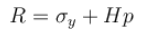
Multilinear hardening:
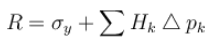
Power hardening:
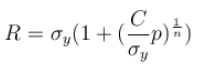
Exponential hardening (saturation):

Parabolic hardening:
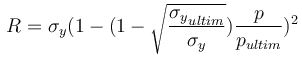
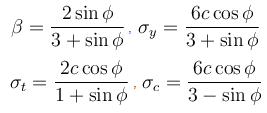
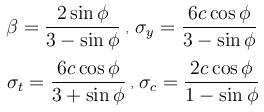
The Drucker-Prager flow surface is either described or inscribed in a hexagonal Coulomb-Mohr cone with the parameters given below.
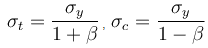
Matching parameters:
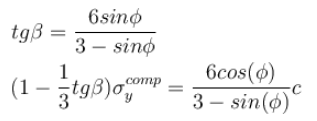
angle of internal friction (dilatancy) φ and coupling coefficient c (cohesion):
- described cone:
- inscribed cone:
tensile stresses σt and compression σc:
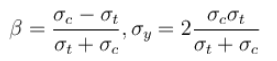
The hardening module is used in the form of:

E is Young's modulus, σu and εu are the limiting voltage and complete deformation.
Implemented multi-module hardening:
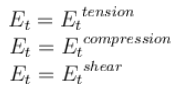
The sign of compression/stretching is determined by the sign 1 of the invariant of elastic deformations, modulus for shear in the case of zero.
Ansys:
full match (for an inscribed cone).
Abaqus:
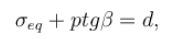
d - cohesion, β - dilatancy angle

Parameters: dilatancy angle, tensile/compressive/shear yield strength σytens, σycomp, d.
Compliance with Fidesys:
References
1. Drucker, D. C. and Prager, W. (1952). Soil mechanics and plastic analysis for limit design. Quarterly of Applied Mathematics, vol. 10, no. 2, pp. 157—165.
2. Code-Aster manual
3. Abaqus User's Manual