Search the documentation
Enter at least 2 characters
Enter at least 2 characters
 |
CAE Fidesys 9.0 Documentation |
The problem of the elastic state of a thick-walled pipe is one of the first problems of the theory of elasticity, which was solved by Lame (1828). Let's write equations of Hooke's law:
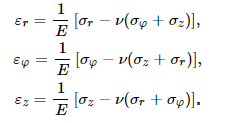
From the last equation:

Let's exclude σz from the first equation:

Likewise:

The equilibrium equation will be satisfied identically if we accept

The function F(r) is called the stress function. According to formulas (2) (2'):
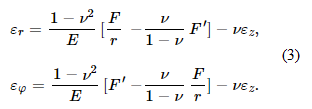
Thus, the deformations are also expressed through the stress function F(r) and the still unknown constant εz. Let us introduce the expression εr and εφ according to formulas (3) into the deformation compatibility equation. We get after layoffs:
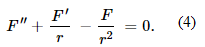
To integrate this differential equation we set F = Crn and substitute this expression for F into (4). After the reduction rn-2 we arrive at the following algebraic equation for the exponent n:

The roots of this equation are n = ±1, so the general integral of equation (4) can be written in the form
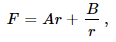
where A and B are integration constants.
The voltages σr and σφ will be expressed as follows:
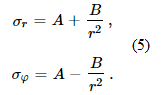
These are Lame's formulas for stresses in a thick-walled pipe. Permanent integrations must be determined from the boundary conditions. Let the inner the radius of the pipe is a, the outer radius is b. Internal pressure is q, external equals zero. This means that the radial stress σr is equal to - q at r = a and equal to zero at r = b. According to the first of formulas (5)
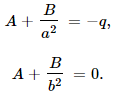
From here we find the constants A and B:
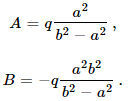
The final formulas for stresses are as follows:
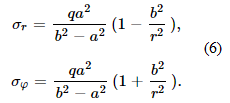
Figure 1 shows graphs (diagrams) of stress distribution across the thickness walls.
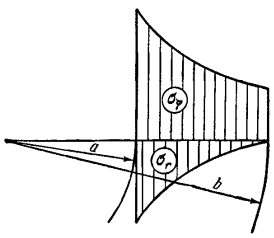
Figure 1. Stress distribution over wall thickness
The stress σz is now determined by the formula:
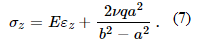
It turns out that σz is constant across the wall thickness. Resultant we denote internal forces in the cross section by P, this is the tensile force or compressing the pipe. If the pipe is closed at the ends, the tensile force equal to the pressure on the bottom, the area of which is πa2. Hence, P = qπa2. The cross-sectional area of the pipe is π(b2-a2). Thus,
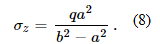
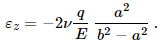
Comparing (7) and (8), we can find the relative elongation εz. If the pipe material is incompressible, ν = 1/2 and εz = 0.
Open at the ends (for example, a gun barrel during a shot) σz = 0, so