Search the documentation
Enter at least 2 characters
Enter at least 2 characters
 |
CAE Fidesys 9.0 Documentation |
Let's consider the process of solving equations for nonlinear processes using the example of static formulation.
After the standard finite element discretization of the equilibrium
equation, the problem boils down to the following: find the vector of
nodal displacements  at a
time
at a
time  satisfying the equation:

(1)
where,  - vectors of internal
and external forces in the nodes, respectively.
- vectors of internal
and external forces in the nodes, respectively.
This equation is nonlinear. In CAE Fidesys, it is solved by the Newton-Raphson iterative method. Each iteration of this method represents the solution of the linearized problem (1).
Let the approximation be known  .
Then the iteration (k) of the Newton-Raphson method reduces to a linear
system of equations:
.
Then the iteration (k) of the Newton-Raphson method reduces to a linear
system of equations:
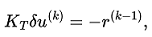

(2)
where  - absolute increments
of forces and increments, respectively (in CAE Fidesys, absolute residuals
- absolute increments
of forces and increments, respectively (in CAE Fidesys, absolute residuals
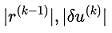 are denoted as ABS. FORCE
RESIDUAL, ABS. VARIABLE RESIDUAL).
are denoted as ABS. FORCE
RESIDUAL, ABS. VARIABLE RESIDUAL).
Having solved the system (2), we update the nodal displacements in the form:
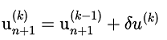
The process of solving by the Newton-Raphson method is illustrated using the figure
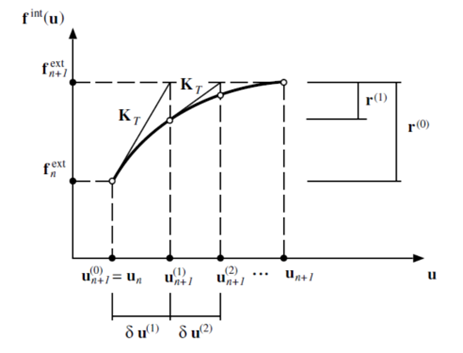
Fig. 1. Illustration of the scheme of the Newton-Raphson iterative method
The criteria for stopping the iterative process depends on the characteristics of the model. Let's look at them in more detail.
We introduce the concept of relative residuals of forces and increments,
respectively: 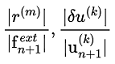 .
.
Their equivalents in CAE Fidesys are designated as REL. FORCE RESIDUAL и REL. VARIABLE RESIDUAL.
Then the rationale for the conclusion about solution (2) and stopping the iterative process follows from the standard sentences:
1) relative residuals by two values (REL. FORCE RESIDUAL and REL. VARIABLE RESIDUAL) or ABS residual. VARIABLE RESIDUAL (for the case when the absolute increments of the model's movements are close to the accuracy of mathematical calculations) has become (have become) less than the threshold.
This criterion is used for calculations with models of plasticity in small deformations, plasticity with contact in small deformations
2) the same as 1) or below the threshold, the ABS residual has decreased. FORCE RESIDUAL (for the case when the absolute increments of the model forces are close to the accuracy of mathematical calculations).
This criterion is used for cases not presented in 1). In fact, we are talking about calculations with finite deformations, possibly going in conjunction with other nonlinearities.
Remarks:
1) the threshold for absolute ABS values. FORCE RESIDUAL, ABS. VARIABLE RESIDUAL is not directly set by the user. It is counted as 1e-8 multiplied by the user-defined relative accuracy;
2) the concepts of the threshold of absolute and relative residuals used are actually set by the user through the relative accuracy parameter. This accuracy is observed by CAE Fidesys in the case when there is no crushing of the substep during the finding. Splitting a substep into several additional steps is used if the Newton-Raphson method does not converge on the original substep. In this case, the threshold is adjusted automatically according to the degree of crushing.