Search the documentation
Enter at least 2 characters
Enter at least 2 characters
 |
CAE Fidesys 9.0 Documentation |
Rocks differ from soils in their behavior mainly in that, as a rule, they have much greater rigidity. The dependence of stiffness on stress values is negligible, so in practice it is considered constant. At the same time, the ability of rocks to resist shear largely depends on the stress level. Since rocks have discontinuities due to the presence of cracks, they can be considered as materials with internal friction. Taking this into account, we can use the Mohr-Coulomb model for calculations. However, it is not universal and is not fully capable of describing the behavior of a rock mass due to a very wide range of stress levels arising in it. It is also known that rocks often exhibit significant tensile strength. Thus, the Hoek-Brown criterion is the most preferred model for calculating the strength of rocks.
The Hoek-Brown fracture criterion was introduced in the early eighties
to describe the shear strength of undisturbed rock subjected to triaxial
tests [1]. The fracture criterion for undisturbed rock is formulated by
the relationship between the greater  and lesser
  principal stresses as

where  - the ultimate
strength of the rock for uniaxial compression, and
- the ultimate
strength of the rock for uniaxial compression, and  – a parameter depending on the type of rock (usually defined on
  ).
).
Both parameters and
can be obtained from regression
analysis of the results of triaxial tests [1-2]. Later, the Hook-Brown
fracture criterion was reformulated and expanded to determine the shear
strength of rock formations. This form of criterion, which is usually
called the generalized Hoek-Brown destruction criterion, can be written
as

In equation (2), compression is successful, which is often found in
rock mechanics and geotechnical engineering. In the context of the mechanics
of complex environments, we consider it to be a full-fledged board. Then,
in further basic applications, we will denote by  and
and  without a stroke.
The coefficients  and
and
 in equation (2) are represented
by semiempirical parameters characterizing the rock mass.
in equation (2) are represented
by semiempirical parameters characterizing the rock mass.
In practice, these parameters are calculated based on an empirical index called the Geological Strength Index or GSI (Geological Strength Index). This parameter ranges from 0 to 100 and can be quantified using graphs obtained as a result of assessing the quality of the rock structure and the condition of its surface [4-5].
In the latest versions of the Hoek-Brown destruction criterion, the
relationship between the coefficients and in equations (2) and GSI is as follows [6-7]
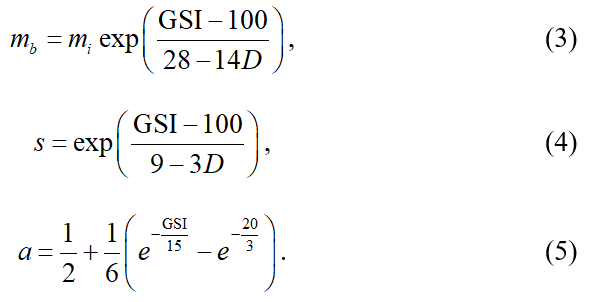
In equations (3) and (4) D – this is a coefficient called the disturbance coefficient, which depends on the degree of rock destruction [2]. Its value varies from 0 to 1.
Based on the above considerations, we write down the yield criterion for the Hoek-Brown model.

where – are the main
stresses, and the tensile stress is assumed to be positive. This means
that stands for the "greatest"
compressive stress.
– are the main
stresses, and the tensile stress is assumed to be positive. This means
that stands for the "greatest"
compressive stress.
The projection of the criterion onto the meridional plane in the main
stress space is shown in Fig. 1. On it, the flow surface is a curve with
a slope tending to infinity as the curve approaches the top of  . At the top
  , and
, and

which is the ultimate tensile strength.
The uniaxial compressive strength  , is shown in
Fig. 1 and can be calculated by specifying
, is shown in
Fig. 1 and can be calculated by specifying  in
equation (6)
in
equation (6)

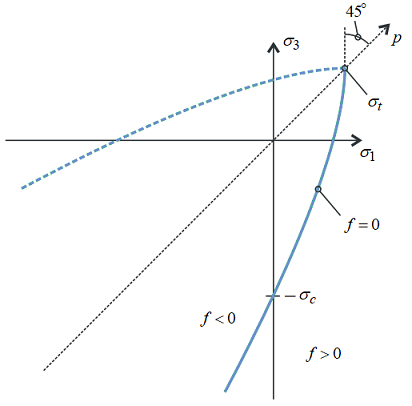
Fig.1 - Projection of the Hoek-Brown criterion onto the meridional plane. The hydrostatic axis is indicated by p. The secondary yield criterion, where σ3 > σ1 is indicated by a dotted line
Thus, the generalized Hoek-Brown criterion can be written

In Fig. 2 let's draw the flow surface in the main axes
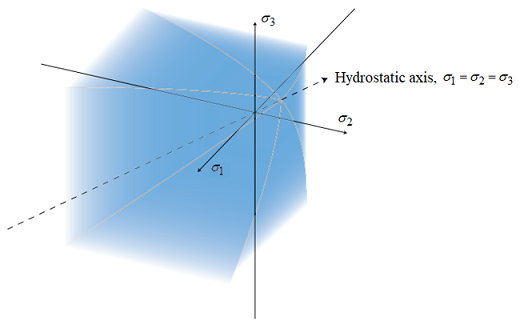
Fig.2 - Generalized Hoek-Brown criterion in the main stress space.
It is in this form that the destruction criterion has been introduced in CAE Fidesys since version 7.1.
1. Hoek, E., & Brown, E. T 1980. Underground excavations in rock. London: The Institute of mining and Metallurgy
2. Hoek, E., Kaiser, P. K. & Bawden, W. F 1995. Support of Underground Excavations in rock. Rotterdam: Balkema
3. Hoek, E., & Brown, E. T 1997, “Practical estimates off rock masses strength”, International Journal of Rock Mechanics and Mining Sciences 34(8), 1165-1186.
4. Hoek, E., Marinos, P. & Benissi, M 1998, “Applicability of the Geological Strength Index (GSI) classification for very weak and sheared rock masses. The case of the Athens Schist Formation”, Bull. Eng. Geol. Env. 57(2), 151-160.
5. Marinos, P. & Hoek, E 2000. GSI: A geological friendly tool for rock mass strength estimation. Proceedings of GeoEng2000, An International Conference on Geological and Geotechnical Engineering. November 2000, Melbourne, Australia.
6. Hoek, E., Carranza-Torres, C. & Corkum, B 2002, “Hoek-Brown failure criterion – 2002 edition”, In R. Hammah, W. Bawden, J.Curran, & M. Telesnicki (Eds.), Proceedings of NARMS-TAC 2002, Mining Innovation and Technology. Toronto – 10 July 2002, pp. 276-273. University of Toronto.
7. Clausen, J., & Damkilde, L 2008, “An exact implementation of the Hoek-Brown criterion for elasto-plastic finite element calculations”, International Journal of Rock Mechanics and Mining Sciences, 45(6), 831-847. doi:10.1016/j.ijrmms.2007.10.004