Search the documentation
Enter at least 2 characters
Enter at least 2 characters
 |
CAE Fidesys 9.0 Documentation |
Creep is the deformation of a solid that occurs over time under constant load.
Relaxation is a phenomenon of spontaneous decrease in tension over time time with constant deformation.
The implemented creep functional is closely related to the plasticity model Drucker-Prager, therefore, when specifying material properties, you must specify yield strength and angle of internal friction. In case it is necessary to consider creep only (no plastic flow) need to specify a high limit flowability: as a result, the material will follow the Drucker-Prager model, subject to creep, but not leaving the elastic zone.
It is possible to identify creep surfaces on which the stress intensity
creep  is constant.
As shown in Fig. 1, in axes
is constant.
As shown in Fig. 1, in axes  such a surface is represented by a line parallel to the yield surface.
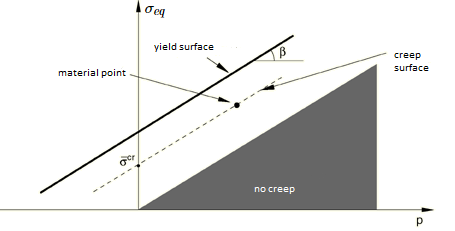
Fig. 1 Creep surface
Yield surface:

where  β - internal
angle friction,
β - internal
angle friction,  - function
strengthening, in the case of ideal plasticity
- function
strengthening, in the case of ideal plasticity 
Total deformations consist of elastic deformations and plastic deformations and creep deformations:

Creep strains correspond to the following equation:

where  A, m, n - given
constants, A and n must be positive,
A, m, n - given
constants, A and n must be positive, 
Fits the Drucker Prager Creep model with the following settings:
Drucker Prager Creep: Law: Strain;
Drucker Prager Hardening: Hardening behavior type: Shear.
Abaqus User's Manual