Search the documentation
Enter at least 2 characters
Enter at least 2 characters
 |
CAE Fidesys 9.0 Documentation |
The problem of bending a square section cantilever beam is considered (side 0.1 m). The material of the beam is steel. One end of the beam is fixed, the other is affected by the force Fy= 1000 N.

In the simplified case, the maximum tangential stress σxz_max occurs on the horizontal axis of the symmetry of the section, constantly along the edge, and is equal to the result of the elementary theory.
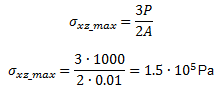
In this case , when deriving formulas , the Poisson 's ratio is assumed to be equal to zero. Strictly speaking, this is not the case, and taking into account the Poisson's ratio makes significant corrections to the solution.
In the Theory of elasticity (Timoshenko S. P., Gudier J.) [1] is considered solving a problem with a Poisson's ratio of 0.25
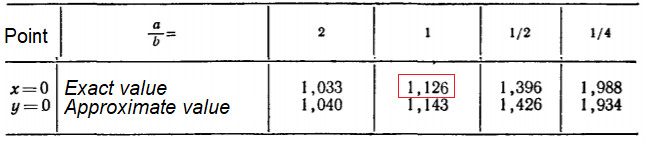
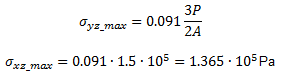
In this case, the maximum tangential stress σxz_max occurs on the horizontal axis of symmetry of the section and changes along the edge according to the parabolic law. The maximum value is equal to the product the result of the elementary theory 3P/(2A) by a coefficient depending on the ratio sides of rectangular cross-section (b/a). In this case, this is the ratio equal to 1.
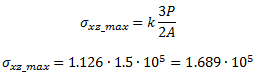
The final value of the stresses:
Tangential stresses σyz_max are determined similarly to stresses σxz_max is the product of the result of elementary theory by the coefficient, obtained from Table 9 (page 370)[1] for the case (b/a)=1.
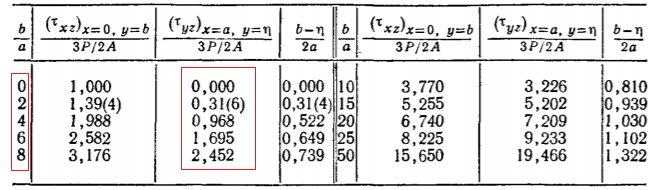
To obtain this value, a polynomial approximation was performed values from the table.
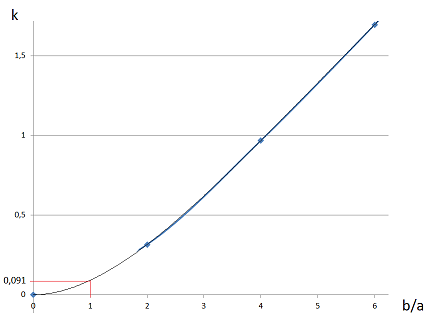
Thus, the value k =0.091 corresponding to the ratio is obtained (b/a)=1. The final value of the voltage σyz_max.
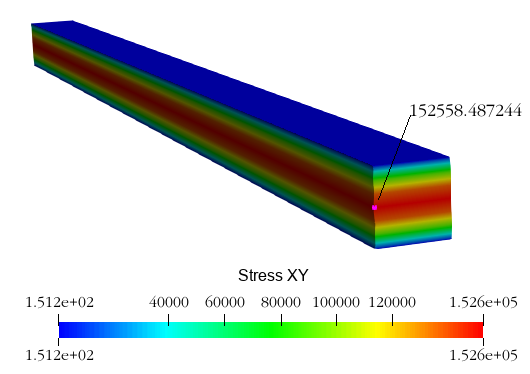
Below are the results of CAE Fidesys calculations using beam elements of the second order beam3.
Solution for zero Poisson's ratio.
Solution for the Poisson's ratio 0.25
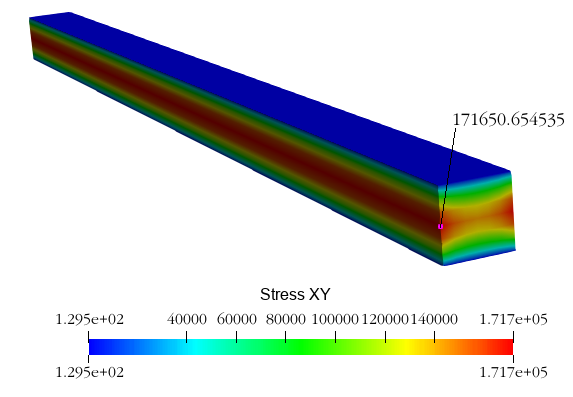
In the latter case, the difference in the solution is 1.6%, which is acceptable the margin of error.
Thus, the beam theory implemented in CAE Fidesys takes into account the influence of the Poisson's ratio, which makes it possible to obtain more accurate solutions for tangential stresses.
References:
[1] Timoshenko S. P., Goodyear J. Theory of elasticity: Trans. from English./Ed. G. S. Shapiro.- 2nd ed. - Moscow: Nauka. The main edition of the physical and mathematical literature, 1979, 560 p. (364-370)