Search the documentation
Enter at least 2 characters
Enter at least 2 characters
 |
CAE Fidesys 9.0 Documentation |
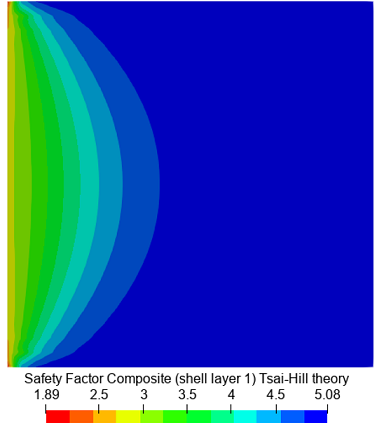
Tsai-Hill theory is a quadratic criterion based on the fourth (energy) theory of strength and based on stress, which can be used to identify fracture, but it is impossible to distinguish the forms of fracture. This criterion is applicable in most cases to composite shells, and it is best to apply it to layered materials when the tensile and compressive forces are equal. The main disadvantage of the criterion is the inability to determine the cause of the destruction of the monolayer: the destruction of the matrix or fiber occurred. In the Tsai-Hill theory, the coefficients are determined depending on the sign of the normal stress acting along the corresponding axis of the material coordinate system of the layer, i.e., depending on whether stretching or compression occurs along this axis. The coefficients are calculated as follows:
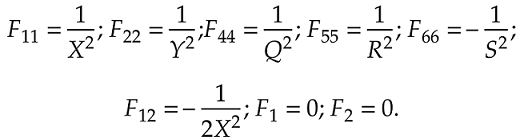
Formulation of the criterion for unidirectional layers: