Search the documentation
Enter at least 2 characters
Enter at least 2 characters
 |
CAE Fidesys 9.0 Documentation |
For materials such as soils, stones and concrete, whose behavior is usually characterized by a strong dependence of the yield strength on the hydrostatic pressure, the corresponding description of plastic fluidity requires the introduction pressure sensitivity. Mohr-Coulomb yield criterion - classical An example of a pressure-sensitive law.
The Mohr-Coulomb criterion Φ(σ,p) is represented as six functions:
Φ1(σ,p)=σ1-σ3+(σ1+σ3) sinφ-2c(p) cosφ≤0
Φ2(σ,p)=σ2-σ3+(σ2+σ3) sinφ-2c(p) cosφ≤0
Φ3(σ,p)=σ2-σ1+(σ2+σ1) sinφ-2c(p) cosφ≤0
Φ4(σ,p)=σ3-σ1+(σ3+σ1) sinφ-2c(p) cosφ≤0
Φ5(σ,p)=σ3-σ2+(σ3+σ2) sinφ-2c(p) cosφ≤0
Φ6(σ,p)=σ1-σ2+(σ1+σ2) sinφ-2c(p) cosφ≤0
c(p) – hardening function (for ideal plasticity it is equal to cohesion c),
σ_i – principal stresses, φ – angle of internal friction.
The Mohr-Coulomb yield surface is a hexagonal cone:
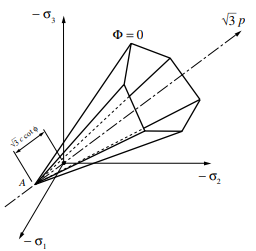
Plastic potential Q(σ,p) has the same form as the plasticity criterion Φ(σ,p) except that the angle of internal friction φ is replaced by the angle dilatancy ψ ≤ φ.